
SOM

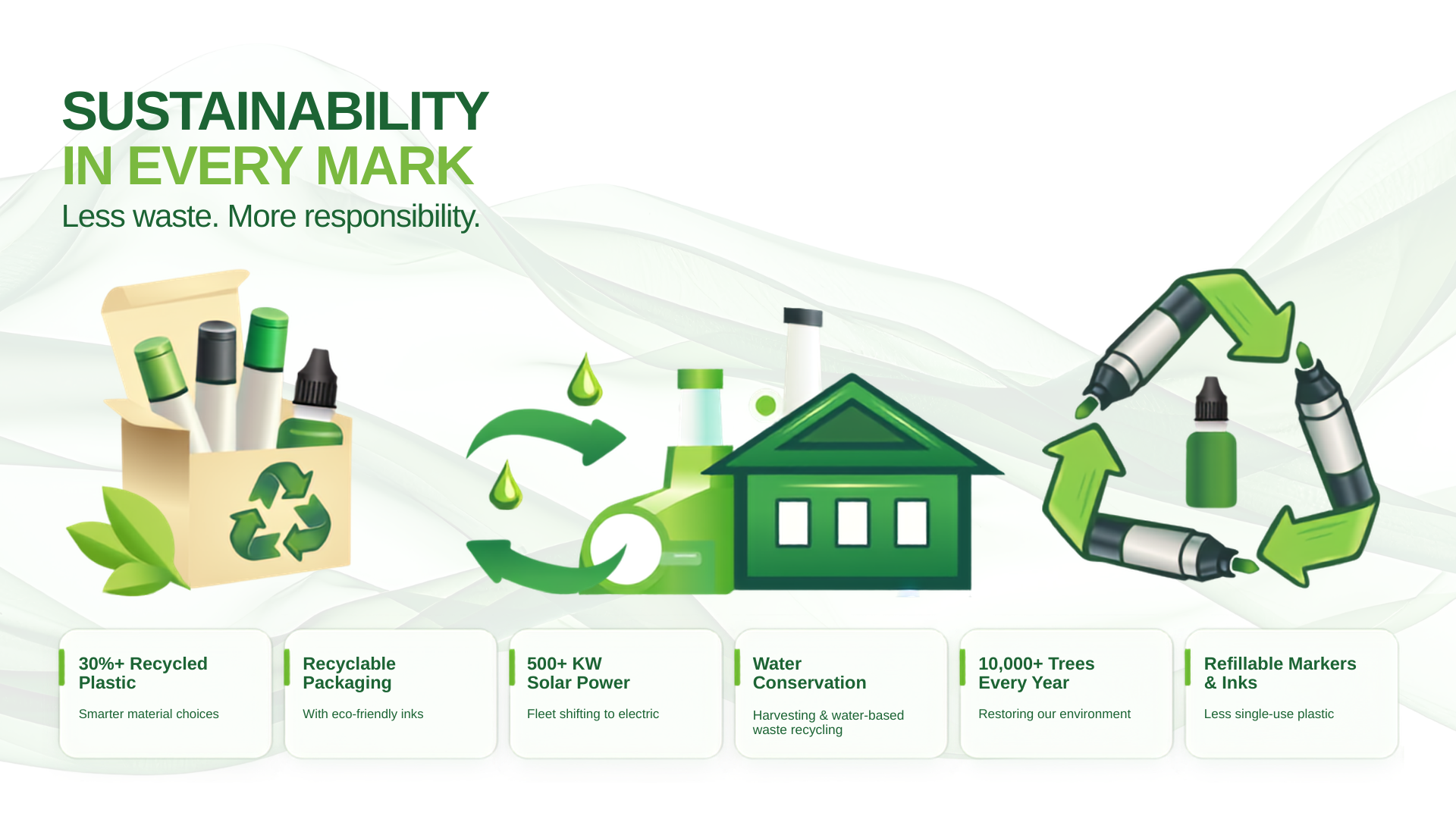
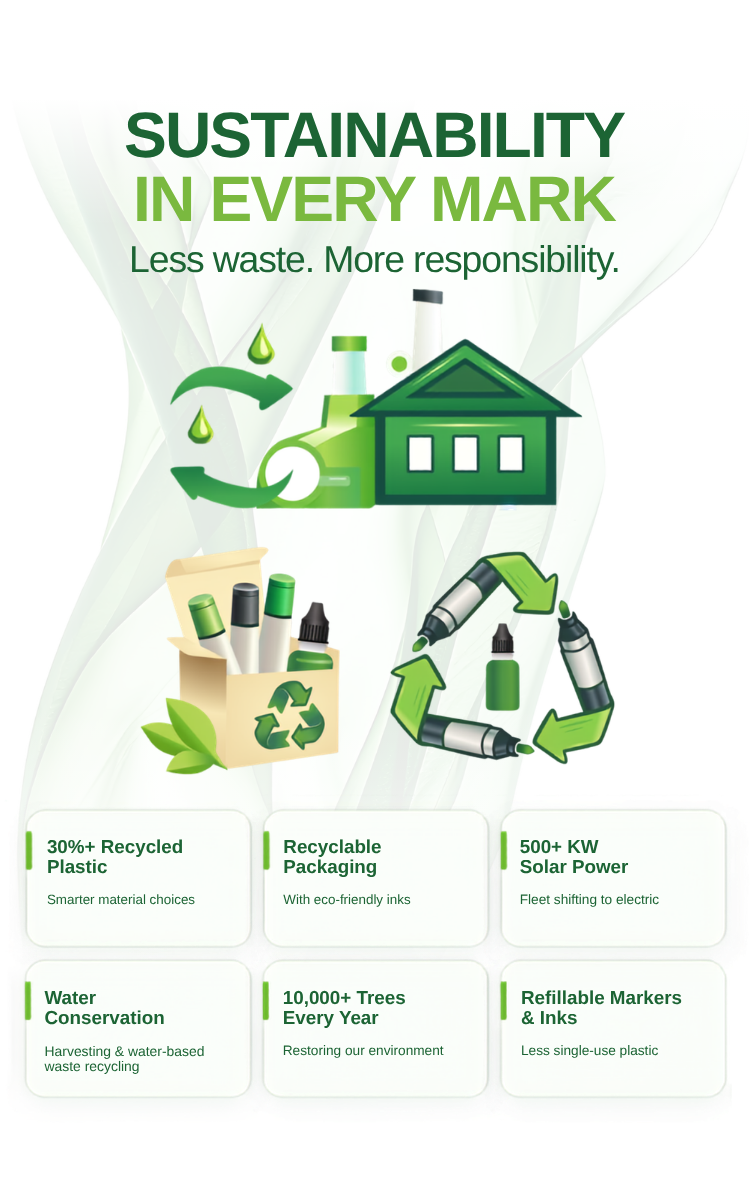
At Soni Officemate, sustainability is an integral part of our commitment to writing a brighter tomorrow. We are continuously working to reduce our environmental impact through recyclable packaging, eco-friendly inks, recycled plastic usage, minimal paper consumption, and responsible waste recycling. Our investment in over 500 KW of solar energy helps power our operations through cleaner renewable sources. We also conserve 5,00,000+ litres of water annually through rainwater harvesting and efficient water management practices. Along with adopting electric vehicles and water-based formulations, we proudly plant 10,000+ trees every year to support biodiversity and a greener future.

Our Impact at a Glance

Tree Planted Yearly
1500 +
Solar Energy Used
100 +
litres of water conserved annually
100000 +

writing A Brighter Tomorrow

Empowering Progress Through Quality Stationery

Recyclable Packaging with Eco-Friendly Inks

Using recyclable cardboard for packaging and eco-friendly inks to minimize environmental impact and promote sustainable branding. Our packaging is designed to be 100% recyclable at end-of-life, reducing plastic waste in landfills. We are continuously working to eliminate harmful chemicals from our printing process, ensuring that every product leaving our facility carries a minimal environmental footprint without compromising on packaging integrity or presentation quality.

Recycled Plastic (>30%)

Incorporating above 30% recycled plastic in products and processes to reduce waste. By sourcing post-consumer and post-industrial recycled plastics, we actively reduce demand for virgin plastic production. This initiative helps divert plastic waste from oceans and landfills, contributing to a circular economy where materials are reused rather than discarded, without compromising on product durability or performance.

Minimal Paper Use

Digitizing operations to significantly reduce paper usage. Internal communications, approvals, invoicing, and reporting are being progressively migrated to digital platforms across all departments. This transition reduces paper consumption at the facility level while improving process efficiency, document traceability, and data accessibility across our teams.

Recycling Production

Implementing waste management systems to recycle leftover paper, plastic, and other materials from the production process, reducing landfill contributions and promoting resource efficiency. We partner with certified recycling agencies to ensure responsible disposal and reuse of industrial waste generated across our manufacturing lines. Every material stream, from ink residues to plastic offcuts, is logged, segregated, and routed through verified recycling channels to minimize what reaches landfill.

Solar Energy

Utilizing over 500 KW of solar power to transition to renewable energy sources. Our rooftop solar installations power a significant portion of daily manufacturing and office operations, reducing our dependence on grid electricity and cutting annual carbon emissions. The 500 KW capacity was commissioned as a long-term infrastructure investment, lowering operational energy costs while supporting India's national renewable energy targets. We continue to evaluate capacity expansion as our operations grow.

Electric Vehicles

Phasing out traditional vehicles in favor of EVs to cut carbon emissions.We are progressively replacing petrol and diesel-powered vehicles with electric alternatives for logistics, delivery, and facility transportation. Dedicated EV charging infrastructure has been installed at our premises to support this transition and ensure operational continuity as the fleet scales toward full electrification.

Water Conservation

Implementing water harvesting and using water-based adhesives and inks. Our rainwater harvesting systems collect and channel water for reuse across facility operations, reducing dependence on external municipal supply. Regular water usage audits help identify consumption inefficiencies and drive targeted reduction measures. The shift to water-based adhesives and inks further reduces the use of solvent-intensive formulations that carry higher environmental and disposal costs.

Planting 10,000+ Trees Every Year

Committed to planting over 10,000 trees annually to enhance biodiversity and offset carbon emissions.These plantings are carried out in collaboration with local communities, NGOs, and environmental organizations to ensure long-term tree survival and ecosystem restoration. Beyond carbon offsetting, the program supports native habitat recovery in and around Nagpur, creating measurable, on-the-ground environmental impact year after year.

Our Production process

01
Raw Material
Selection
Premium dyes, pigments, and resins sourced for quality
02
Precision
Formulation
Balanced composition for smooth flow and consistency
03
Filtration &
Purification
Multi-stage filtration for clean, impurity-free ink
04
Quality
Testing
Testing for viscosity, color, durability, and performance
05
Filling &
Assembly
High-precision filling and secure sealing
06
Packaging &
Distribution
Safe packaging ensuring global delivery
01
Raw Material
Raw Material
Selection
Premium dyes, pigments, and resins sourced for quality
02
Precision Formulation
Precision
Formulation
Balanced composition for smooth flow and consistency
03
Filtration
Filtration &
Purification
Multi-stage filtration for clean, impurity-free ink
04
Quality Testing
Quality
Testing
Testing for viscosity, color, durability, and performance
05
Filling Assembly
Filling &
Assembly
High-precision filling and secure sealing
06
Packaging Distribution
Packaging &
Distribution
Safe packaging ensuring global delivery

FAQs

How much of Soni Officemate's energy comes from renewable sources?

Our Nagpur manufacturing facility has a 500 KW rooftop solar installation that generates approximately 9.5 to 10 lakh kWh (units) of electricity per year under Nagpur’s average solar irradiance. This covers an estimated 55 to 65% of our total facility electricity consumption. We are evaluating an expansion to 750 KW by FY2026-27, which would bring our renewable energy share above 80% of total consumption.

More than 30% of the plastic used in our product barrels, caps, and housing components is sourced from post-consumer or post-industrial recycled resin rather than virgin plastic. At our current scale of 3 million+ markers per day, this equates to approximately 1,500 to 1,600 metric tonnes of recycled plastic processed annually. We are targeting 40% recycled content across our full plastic portfolio by FY2027.

Yes. Our marker inks are primarily water-based, with whiteboard marker inks formulated to a VOC content below 50 g/L. No substances on the REACH SVHC (Substances of Very High Concern) candidate list are intentionally used in our formulations. Specialty inks using alcohol-based carriers still comply with REACH chemical restrictions. Ink waste from production is processed through our CPCB-compliant effluent treatment facility.

We commit to planting a minimum of 10,000 trees per year across Nagpur and surrounding districts in partnership with local NGOs and the Nagpur Municipal Corporation. We prioritize native species: Neem, Peepal, and Arjun, which are drought-tolerant and ecologically appropriate to the Vidarbha region. Since 2020, this program has resulted in 50,000+ trees planted cumulatively.

Approximately 85% of our packaging by weight is paper and cardboard, recyclable through standard municipal waste streams. Packaging inks are water-based. We do not use PVC shrink wrapping on domestic SKUs. A 2023 packaging audit led to a 12% reduction in carton grammage across our top 8 domestic SKUs, saving an estimated 18 to 20 metric tonnes of cardboard annually. The remaining 15% (polybags for export moisture protection) is being addressed through PE-reduction alternatives.

We have not yet completed a formal Scope 1, 2, and 3 GHG audit to the GHG Protocol standard. However, our solar installation alone displaces an estimated 800 to 850 metric tonnes of CO2-equivalent per year relative to full grid dependency, based on India’s grid emission factor of approximately 0.82 kg CO2/kWh. A formal carbon baseline assessment is planned for FY2026-27 in anticipation of export market sustainability disclosure requirements.